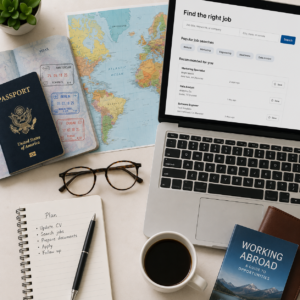
Job seeker visa: that’s the phrase that solves the wait. Work Abroad without the wait: chasing a job offer before you even have a visa is one of the most frustrating parts of moving abroad. The good news? A job seeker visa flips that script. Instead of waiting for an employer to sponsor you from thousands of miles away, a job seeker visa lets you fly in, network in person, attend interviews, and accept an offer on the ground — all before you’ve signed a single employment contract.
Below is a fully verified, 2026-updated breakdown of nine countries that issue a job seeker visa (or an equivalent job-search residence permit) without requiring a prior job offer. We cover eligibility, real duration, and what each job seeker visa actually lets you do — plus how to avoid the paperwork mistakes that sink most applications.
Jump to a country: Germany · Portugal · Czech Republic · Austria · Netherlands · Canada · Australia · New Zealand · UAE
Why a Job Seeker Visa Beats Applying From Home
Recruiters everywhere favor candidates who can walk into an office for a same-week interview. A job seeker visa puts you in that position legally, without needing a sponsor lined up first. It’s also the fastest way to test a country’s job market, cost of living, and culture before committing to a permanent move. That said, every job seeker visa comes with its own eligibility bar, funding requirement, and clock — so getting the details right matters more than it might seem.
Think about the alternative: applying for jobs remotely from your home country, hoping a hiring manager overseas takes a chance on sponsoring a work visa for someone they’ve never met in person. It rarely happens fast, and it almost never happens for mid-level roles. A job seeker visa solves that problem by putting you physically on the ground, where you can attend interviews same-week, build a local network, and demonstrate you’re serious about relocating — all advantages that are nearly impossible to replicate from abroad.
1. Germany: Job Seeker Visa
Purpose: Lets skilled, non-EU professionals enter Germany to search for a job matching their qualifications.
Eligibility:
- A recognized university degree or equivalent vocational qualification (verified through ANABIN or ZAB).
- Proof of financial resources — typically a blocked account (Sperrkonto) funded at roughly €1,091 per month, or a formal sponsor declaration (Verpflichtungserklärung).
- Valid health insurance for the full stay.
Duration: Up to 6 months, non-extendable, for applicants applying from outside Germany. (Note: international graduates of German universities get a separate, longer 18-month job-search residence permit under a different rule — don’t confuse the two.)
Benefits: Multiple entries during the visa period, and if you land a job, you can convert directly to a work residence permit without leaving the country.
Source: How to Germany — Job Seeker Visa
2. Portugal: Job Seeker Visa
Purpose: Gives non-EU nationals a window to search for employment inside Portugal.
Eligibility:
- A bachelor’s degree or higher qualification.
- Proof of sufficient financial resources for the stay.
- Valid health insurance coverage.
Duration: 120 days, extendable once for an additional 60 days (180 days total).
Benefits: No job offer required upfront — this job seeker visa is one of the most accessible entry points into the EU labor market for qualified professionals.
Source: Global Law Experts — Portugal Job Seeker Visa Process
3. Czech Republic: Long-Term Visa for Job Seeking
Purpose: Allows qualified individuals to live in the Czech Republic while applying to local employers.
Eligibility:
- Completed university studies or recognized vocational education.
- Proof of accommodation and adequate financial resources.
Duration: Up to 9 months.
Benefits: One of the longest job-search windows in Europe, giving candidates real time to network and interview locally rather than racing a short clock. Note: this specific long-term residence permit is generally reserved for people who already hold a Czech study or research residence permit and have just completed it — it isn’t an open-entry job seeker visa for applicants abroad, so confirm current eligibility before you apply.
Source: Czech Republic Ministry of the Interior — Long-Term Residence Permit for Seeking Employment
4. Austria: Job Seeker Visa (Red-White-Red Card Category)
Purpose: A points-based route for “Very Highly Qualified Workers” who want to search for employment inside Austria.
Eligibility:
- Score at least 70 out of 100 points across education, work experience, language ability, and age.
- Proof of funds to support yourself for the visa period.
Duration: 6 months, non-extendable.
Benefits: This job seeker visa does not itself grant work rights, but the moment you secure a qualifying job offer meeting Austria’s minimum salary threshold, you can convert directly to a two-year Red-White-Red Card without leaving the country.
Source: AbroadMate — Austria Red-White-Red Card 2026
5. Netherlands: Orientation Year (Zoekjaar)
Purpose: Gives recent graduates a full year to find work or start a business in the Netherlands.
Eligibility:
- Graduated from an accredited Dutch university (bachelor’s, master’s, or PhD), or
- Graduated from a university ranked in the top 200 globally (THE, QS, or Shanghai rankings) with a master’s or PhD, or
- Completed scientific research in the Netherlands under a research permit.
- Must apply within 3 years of graduation or research completion.
Duration: 12 months, non-renewable as a Zoekjaar permit.
Benefits: No work-hour restrictions and no work permit required — you can take any job, freelance, or launch a business. Zoekjaar holders also qualify for a reduced salary threshold when transitioning to the Highly Skilled Migrant visa, making this arguably the most flexible job seeker visa on this list.
Source: Visa Atlas — Orientation Year (Zoekjaar), Netherlands
6. Canada: International Experience Canada (IEC)
Purpose: Lets eligible young people from partner countries live and work in Canada, functioning as an open-ended alternative to a traditional job seeker visa.
Eligibility:
- Must be a citizen of one of the 36 countries with a Youth Mobility Agreement with Canada.
- Typically aged 18–30 or 18–35, depending on your country’s specific agreement.
- Sufficient funds and a return ticket (or funds to purchase one).
Duration: Up to 2 years, depending on your country’s agreement and category (Working Holiday, Young Professionals, or International Co-op).
Benefits: The Working Holiday category issues an open work permit, meaning you can work for almost any employer, anywhere in Canada, without it being tied to a specific job.
Source: Government of Canada — International Experience Canada
7. Australia: Working Holiday Visa (Subclass 417)
Purpose: Combines travel and work for young people from eligible countries.
Eligibility:
- Generally aged 18–30 (up to 35 for citizens of certain countries, including the UK, Canada, and Ireland).
- Citizen of an eligible partner country.
- Proof of sufficient funds for the initial stay.
Duration: 12 months, with extension options for those who complete specified regional work.
Benefits: Freedom to work almost anywhere in Australia while exploring the job market and traveling.
Source: Australian Government Department of Home Affairs — Working Holiday visa (subclass 417)
8. New Zealand: Working Holiday Visa
Purpose: Lets young travelers fund an extended stay in New Zealand through casual or short-term work.
Eligibility:
- Generally aged 18–30 (up to 35 for a handful of eligible countries).
- Proof of sufficient funds.
- Citizen of an eligible country.
Duration: 12 months for most nationalities, with some country-specific exceptions running shorter or longer.
Benefits: Flexibility to travel, live, and work casually across New Zealand without a fixed employer.
Source: Immigration New Zealand — Working Holiday Visas
9. UAE: Job Seeker Visa (Job Exploration Entry Permit)
Purpose: Officially called the Job Exploration Entry Permit, this job seeker visa lets qualified professionals enter the UAE without a sponsor to interview and network in person.
Eligibility:
- A bachelor’s degree or equivalent, matched to MOHRE Skill Levels 1–3 (managers, professionals, technicians), or
- A recent graduate (within 2 years) of a top-ranked global university.
- Valid passport and proof of financial resources.
Duration: Choose 60, 90, or 120 days at the time of application. A 60- or 90-day visa can generally be extended once, though the total stay cannot exceed 180 days.
Benefits: It’s a visit visa, not a work permit — you cannot draw a salary on it — but once an employer confirms a hire, the conversion to a UAE work residence visa can happen without you leaving the country.
Source: The Official Portal of the UAE Government — Jobseeker Visit Visa
Common Documents for a Job Seeker Visa Application
Across nearly every job seeker visa program, immigration authorities expect a similar core document set:
- Valid passport — usually with at least 6 months’ validity beyond your travel dates.
- Proof of financial resources — bank statements, a blocked account, or a sponsor declaration showing you can support yourself.
- Health insurance — coverage for the entire duration of your stay.
- Proof of accommodation — a rental agreement or hotel booking.
- Educational certificates — certified copies, sometimes with formal recognition/equivalency documents.
- Completed visa application form for the specific country.
- Passport-size photos meeting that country’s specifications.
- Cover letter outlining your job search plan and intentions.
- Travel itinerary, where required.
Missing or inconsistent documents are the single biggest reason job seeker visa applications get delayed or rejected — so it’s worth having every item verified before you submit.
How to Choose the Right Job Seeker Visa for You
With nine options on the table, picking the right job seeker visa comes down to three questions:
- How much time do you realistically need? A 60-day UAE visa suits someone with interviews already lined up; a 12-month Dutch Zoekjaar suits someone starting from scratch.
- Do you meet the qualification bar? Austria’s points system and the Netherlands’ university-ranking requirement are strict — check eligibility before you spend on translations and attestations.
- What’s the cost of staying funded? Every job seeker visa requires proof of funds, and thresholds vary widely — from a few thousand euros in blocked accounts to structured salary requirements once you convert to a work permit.
How Callmaimo Consulting Can Help
Reading eligibility criteria is one thing — building a job seeker visa application that actually clears embassy review is another. This is where Callmaimo Consulting comes in.
Callmaimo Consulting specializes in guiding candidates through the exact process outlined above: matching you to the right country and job seeker visa category, preparing and verifying your documents (degree recognition, financial proof, cover letters), and reviewing your application before submission to reduce the risk of rejection or delay. If your goal is Germany, Portugal, the Netherlands, Austria, Canada, Australia, New Zealand, or the UAE, Callmaimo Consulting can help you understand which job seeker visa fits your qualifications, budget, and timeline — and can support you all the way through to converting your visa into a full work permit once you land a job.
If you’re serious about working abroad in 2026, getting expert eyes on your application before you submit it is one of the highest-leverage steps you can take.
Frequently Asked Questions About the Job Seeker Visa
Is a job seeker visa the same as a work visa? No. A job seeker visa only permits you to search for employment — attending interviews, networking, and exploring the market. You generally cannot legally work or draw a salary until you convert it into a work permit after securing a job offer.
Which job seeker visa is easiest to qualify for? It depends on your profile. Portugal and the Czech Republic have comparatively accessible entry requirements for degree holders, while Austria’s points-based job seeker visa and the Netherlands’ Zoekjaar are more selective but offer longer stays.
Can I bring my family on a job seeker visa? This varies by country. The Netherlands’ Orientation Year, for example, allows dependents to apply for their own residence permits alongside the primary applicant. Always check the specific country’s family-reunification rules before applying.
How long does a job seeker visa application take to process? Processing times range from a few working days (UAE) to several weeks (Germany, Netherlands). Apply well ahead of your intended travel date, and confirm current processing times with the relevant embassy or consulate.
Final Thoughts
A job seeker visa removes the biggest barrier to working abroad: the chicken-and-egg problem of needing a job offer to get a visa, and a visa to get interviews. Whether you’re eyeing Germany’s structured 6-month window, the Netherlands’ generous 12-month Orientation Year, or the UAE’s flexible 60-to-120-day Job Exploration Entry Permit, there’s a job seeker visa built for nearly every profile of skilled worker or young professional.
Do your homework on eligibility, get your documents in order early, and — if you want to skip the trial and error — let Callmaimo Consulting help you turn this list into an actual offer letter.
Immigration rules change frequently. Always confirm current requirements, fees, and processing times with the relevant embassy, consulate, or official government immigration portal before applying.
Editorial note: Every outbound link in this article — to official government immigration portals (Canada, Australia, New Zealand, UAE, Czech Republic) and to reputable third-party immigration resources (Germany, Portugal, Austria, Netherlands) — is a standard, followed link. None of these links use rel="nofollow", rel="sponsored", or rel="ugc" attributes; when this markdown is published, ensure your CMS or theme doesn’t auto-append nofollow to outbound links, since these citations are added for reader trust and source transparency, not as paid or user-generated content.